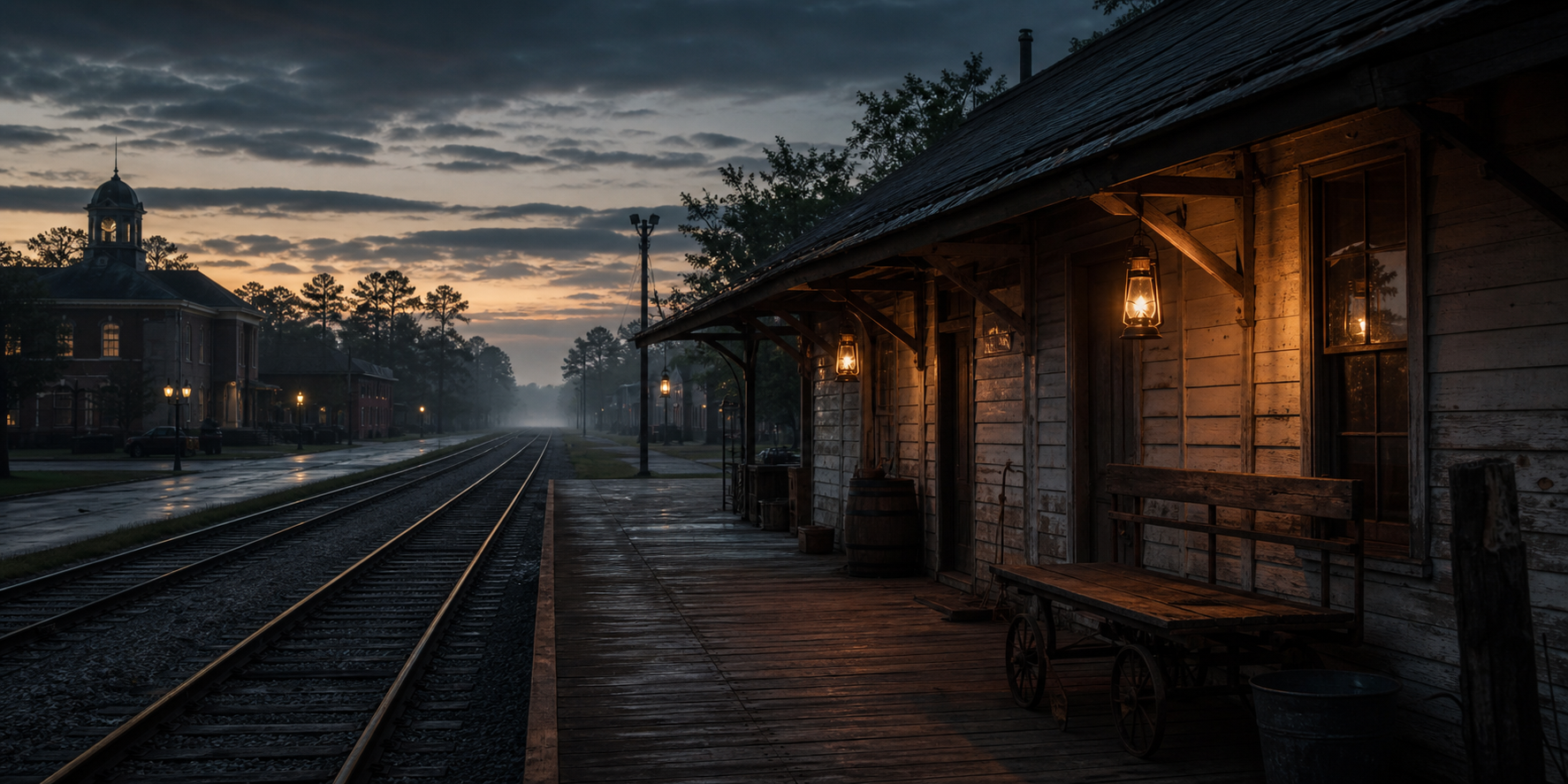
Guntown is a small town with a memorable name and a long memory. The Booth legend belongs to the shelf where family tradition, cemetery markers, rail stories, and official history sit close enough to trouble one another.
Official recordThe Official Story
The accepted historical account says John Wilkes Booth assassinated President Abraham Lincoln at Ford's Theatre in Washington, D.C., fled through the region around Washington, Maryland, and Virginia, and was found at Garrett Farm near Port Royal, Virginia. In that account, Booth was shot in the Garrett barn and died on April 26, 1865. The official record also treats the body examined aboard the USS Montauk as Booth's body.
Local loreThe Guntown Legend
The Guntown version tells the story differently. In local lore, Booth allegedly survived, came to Mississippi, and became connected to Guntown through the Booth family, rail travel, an upstairs hiding place, and later cemetery stories.
This site does not present that claim as proven. It treats the legend as civic folklore: a story worth preserving because people remembered it, repeated it, and attached it to real names and places.
Family traditionDr. John Fletcher Booth
The reported Guntown tradition centers on Dr. John Fletcher Booth, described in the later HottyToddy retelling as a Booth relative who sheltered John Wilkes Booth in or near Guntown. That relationship and sheltering claim remain family-tradition material here unless a stronger primary source is found.
Family traditionThe Girl and the Attic
One of the most vivid pieces of the story is Jennie Booth Epting. The later retelling describes her as the "little girl who helped carry food to JWB in his upstairs hiding place."
That phrase is included as reported local and family lore. It is not presented as Jennie's direct firsthand quotation. The original 1995 Tupelo Daily Journal / Phyllis Harper interview with Emma Emily Epting Pressey has not been located in public web sources yet.
Place traditionThe Cemetery
Smith Cemetery is part of the Guntown Booth story because the local tradition connects it to a claimed Booth marker or grave tradition. The cemetery connection is a local artifact of memory. It should not be read as authenticated proof of Booth's burial.
Why the Story Endures
Stories like this endure because small towns preserve more than documents. They preserve family names, old houses, railroad memory, cemetery paths, and claims that remain unsettled long after the official file has closed.
Whether history, folklore, or something in between, the Booth legend gives Guntown one more reason to be remembered.